
The Three Models for Agent Payments: Virtual Cards, IOU Tokens, and Crypto
Most guides to AI agent payments treat the question as settled: give your agent a virtual credit card, set a limit, done. That misses two other architectures that exist right now and work differently at different scales and transaction types.
There are three distinct models for agent payments. Each makes different tradeoffs. Understanding all three helps you pick the right one — and avoid the wrong one at scale.
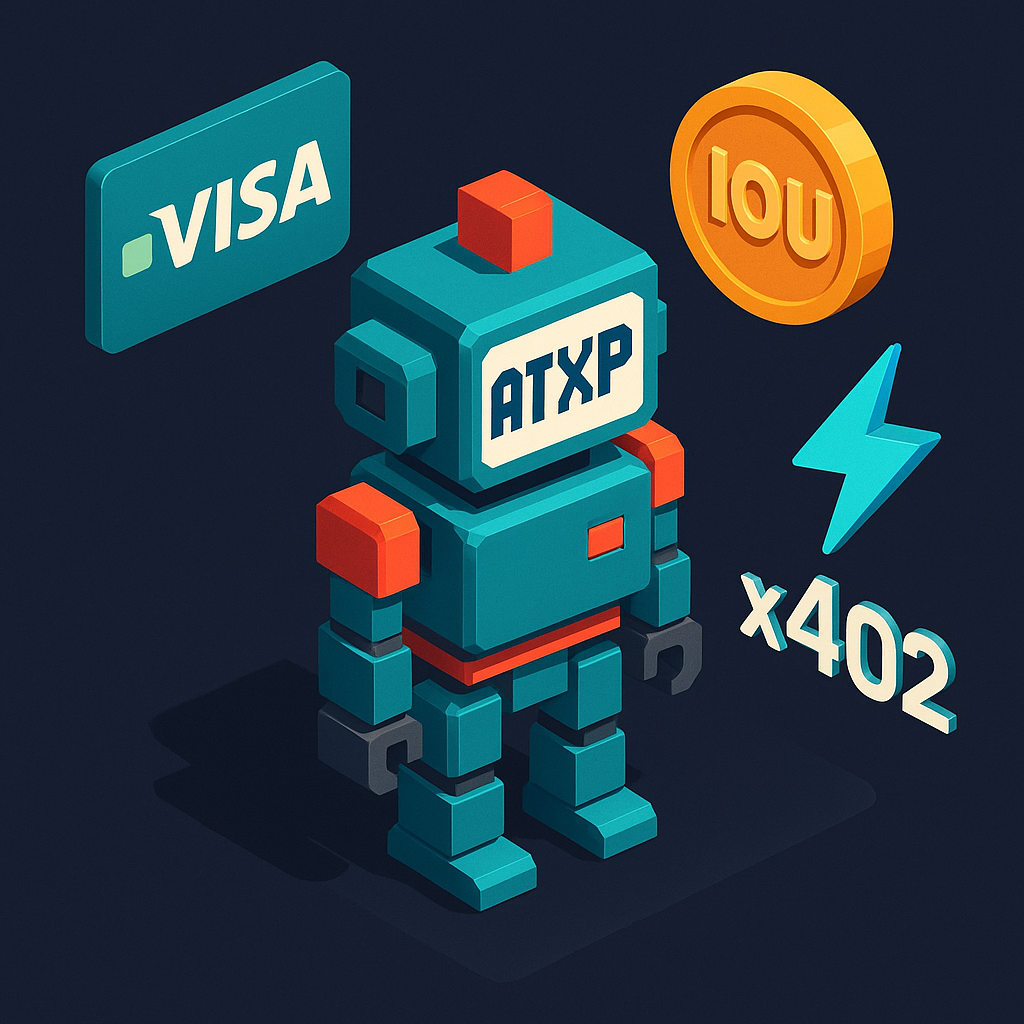
The three models
There are three architectures for giving an AI agent the ability to pay for things: virtual prepaid cards, IOU tokens, and HTTP-native crypto payments (x402). Each works at a different layer of the stack and suits different transaction types.
| Model | How it works | Best for | Minimum transaction | Network dependency |
|---|---|---|---|---|
| Virtual card | Prepaid Visa/MC credentials, balance = ceiling | SaaS subscriptions, one-off purchases | ~$0.50 (card network minimums) | Visa/Mastercard required |
| IOU token | Pre-funded account balance, deducts per call (like a Starbucks wallet or airline eCredits) | High-frequency tool calls, sub-cent operations | $0.001 | None (issuing ecosystem) |
| x402 / crypto | HTTP 402 response triggers payment, agent pays and retries | API-to-API micropayments | Sub-cent | x402-enabled service required |
Model 1: Virtual prepaid cards
The virtual card model is the oldest and most widely deployed approach. You load a prepaid Visa or Mastercard with a fixed balance, give the card credentials to the agent, and the agent uses them to make purchases anywhere that accepts cards.
How the spending ceiling works: The card balance is the hard limit. The agent can’t spend more than what’s loaded. When the balance hits zero, the card declines. This is a network-enforced constraint — it doesn’t rely on the agent behaving correctly.
What it’s good for: Anything that requires a real card number. SaaS subscriptions, cloud credits, software licenses, online retail. If a merchant’s checkout flow requires a Visa, this is the only model that works without custom integration.
Where it breaks down:
Card networks charge interchange fees on every transaction — typically 1.5–3.5%. On a $0.005 web search query, the fee exceeds the transaction value. Virtual cards are economically impractical for sub-dollar transactions and completely unworkable for sub-cent ones.
There’s also a per-card overhead problem. The recommended pattern for virtual cards is one card per task — issue a card, run the task, revoke the card. At low frequency (10 tasks/day) this is manageable. At 1,000 tasks/day, the issuance, tracking, and revocation overhead becomes significant. More on this in why virtual cards don’t scale at volume →.
Model 2: IOU tokens
The IOU token model doesn’t use a card network at all. Think of it like dollars held in a Starbucks wallet or eCredits with an airline — you pre-fund a balance, and each tool call deducts from it at a published per-call rate. The tokens are spendable within the issuing ecosystem, not universally.
An IOU token is a pre-funded credit unit that gives an AI agent spending power without a card network — similar to dollars held in a Starbucks wallet or eCredits with an airline. Each tool call deducts from the balance at a published rate. When the balance reaches zero, the agent stops — it cannot overdraft. The ceiling is structural, not behavioral.
How the spending ceiling works: The IOU balance is the ceiling. There’s no minimum transaction size — a $0.003 web search query is just as valid as a $10 purchase. The agent spends from the balance across all tool calls; the balance is a single audit trail.
What it’s good for: High-frequency tool calls where sub-cent transactions are normal — web searches ($0.003–0.005), image generation ($0.04), email sends ($0.002), code execution runs. When an agent is making hundreds of tool calls per task, paying card network fees on each one would cost more than the tools themselves.
It’s also the right model when one account should cover multiple tool types. With ATXP, a single IOU balance covers web search, browsing, image generation, email, code execution, file storage, and payments — no separate API keys or billing accounts per tool.
Where it breaks down: Doesn’t work for third-party merchants who require a real card number. You can’t buy a Shopify subscription or pay a SaaS invoice from an IOU balance — you need a card for that.
"Economic actors — stress both words independently. Eyes, ears, hands, legs, and a wallet."
 Louis Amira, co-founder, Circuit & Chisel
The IOU token model is what makes the “wallet” part of that description real at scale. A card works for human-scale purchasing. A pre-funded balance with per-call deduction works for agent-scale tool use.
Model 3: x402 / HTTP-native crypto payments
x402 uses HTTP’s existing 402 Payment Required status code for machine-to-machine payments. When an agent requests a resource that costs money, the server returns a 402 response with payment instructions. The agent processes the payment and retries the request.
How the spending ceiling works: The agent’s wallet or signing key controls the ceiling. Payments are cryptographic — once made, they’re settled. No card network, no intermediary.
What it’s good for: API-to-API micropayments where both sides are developer services. A data API that charges $0.0001 per query. A compute service that charges by the millisecond. Transactions too small for card economics but too frequent for human billing cycles.
Where it is right now: Early. The number of x402-enabled services is measured in hundreds, not millions. No major SaaS platform accepts x402 payments today. For production agents that need to interact with real-world merchants, x402 is a 2027 story more than a 2026 story.
| Capability | Virtual card | IOU token | x402 |
|---|---|---|---|
| Works at existing merchants | ✓ | ✗ | ✗ |
| Sub-cent transactions | ✗ | ✓ | ✓ |
| High-frequency (1000+ calls/day) | Limited | ✓ | ✓ |
| Card network fees | Yes (1.5–3.5%) | No | No |
| Adoption today | Universal | Issuing ecosystem | Hundreds of services |
| Human approval required | At funding | At funding | At wallet setup |
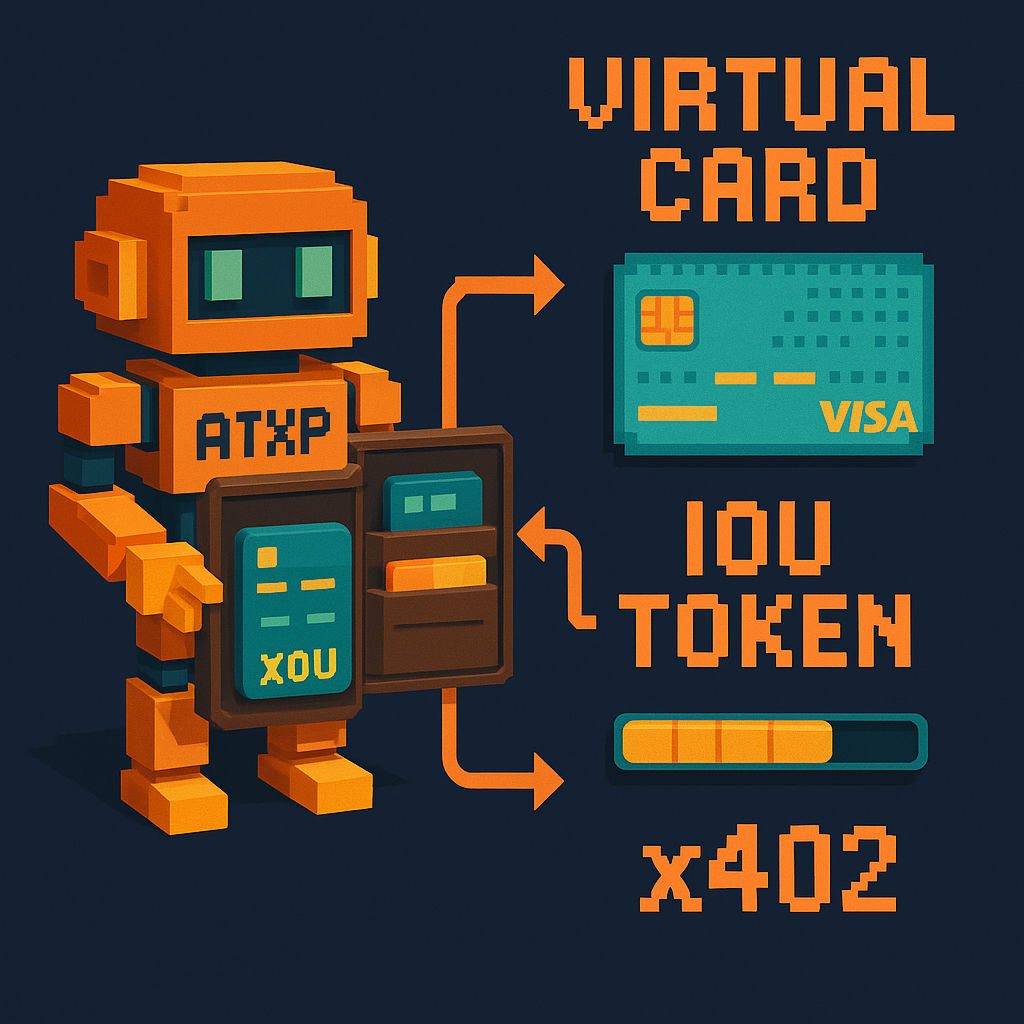
Which model should you use?
Use virtual cards when:
- The merchant requires a real card number (SaaS subscriptions, cloud credits, retail)
- Transaction frequency is low (under 100/day)
- You need universal merchant acceptance without custom integration
Use IOU tokens when:
- You’re making hundreds or thousands of tool calls per day
- Transaction values are sub-dollar or sub-cent
- You want one balance to cover multiple tool types
- You want a single audit trail across all tool calls
Use x402 when:
- You’re building API-to-API services where both sides can adopt the protocol
- You need sub-cent economics without the overhead of card issuance
- You’re building for the next two years, not just today
Most production agent stacks end up using more than one. IOU tokens for tool infrastructure, virtual cards for third-party merchant purchases, x402 as it matures.
That’s the point of ATXP: it’s designed to be compatible with all three models. ATXP partners with virtual card providers and x402, so your agent stack doesn’t have to choose — ATXP sits across all payment methods and handles routing between them.
npx atxpIOU tokens for tool calls. Virtual cards vs IOU tokens → · How agents pay for API calls → · Spending limits →
Frequently asked questions
What are the three models for AI agent payments?
Virtual prepaid cards (works anywhere Visa does), IOU tokens (pre-funded balance, per-call deduction — like a Starbucks wallet or airline eCredits, usable within the issuing ecosystem), and x402 (HTTP-native crypto micropayments). Each suits different transaction types and scales differently.
Which model is best for high-frequency tool calls?
IOU tokens. Card network fees make virtual cards uneconomical at sub-dollar transaction values, and per-card issuance overhead doesn’t scale. IOU tokens deduct from a single balance per call with no minimums.
Which model works with existing merchants?
Virtual cards only. SaaS subscriptions, cloud credits, and retail purchases require a real card number. IOU tokens and x402 require the merchant/service to integrate the payment model.
Is x402 production-ready?
Early stage. Hundreds of services support it today; millions do not. Strong for developer-to-developer API payments; not yet viable for general merchant commerce.
Can an agent use more than one model?
Yes — and ATXP is built for exactly that. ATXP partners with virtual card providers and x402, so a single ATXP integration gives your agent access to all three payment models. Full comparison →
What does ATXP use?
ATXP runs on IOU tokens for tool calls (web search, image gen, email, code execution, file storage), and partners with virtual card providers and x402 for everything outside the ecosystem. That compatibility across all payment methods is the point. How it works →