
Which AI Frameworks Support Autonomous Agent Payments in 2026?
No major AI framework ships with native payment capability. LangChain, CrewAI, the OpenAI Agents SDK, and Claude Code can all call tools autonomously — but what tools they can call, and how they access spending capability, depends entirely on what you add.
Here’s where each framework stands on autonomous payments in 2026, and what it takes to give your agent a funded wallet.
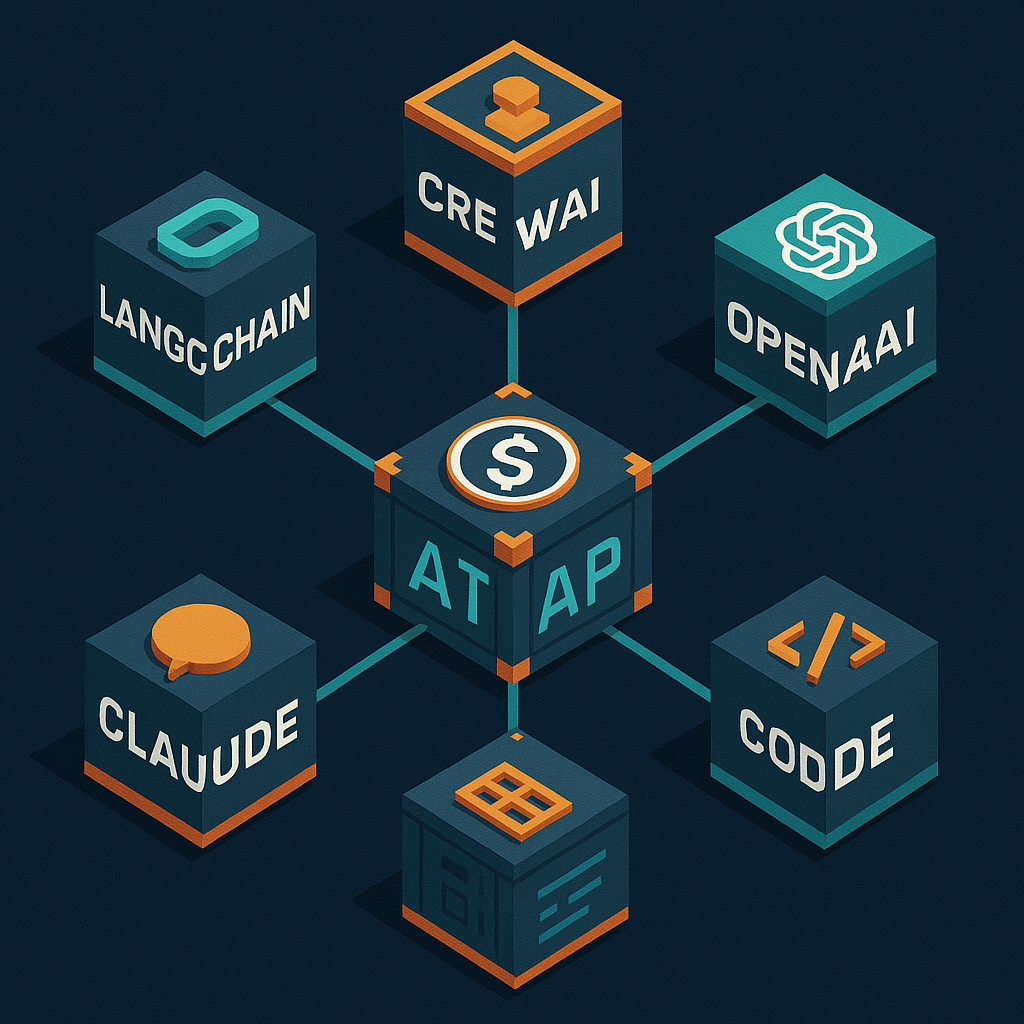
Payment capability by framework
| Framework | Native payment support | Integration method | Full tool access |
|---|---|---|---|
| Claude Code | None native | npx atxp (MCP) | All 14+ ATXP tools |
| LangChain | None native | AtxpToolkit.from_env().get_tools() | All 14+ ATXP tools |
| CrewAI | None native | AtxpToolkit.from_env().get_tools() | All 14+ ATXP tools |
| OpenAI Agents SDK | None native | get_atxp_tools() from atxp.openai | All 14+ ATXP tools |
| AutoGPT | Plugin-based | Custom integration | Varies |
| Custom HTTP agents | None native | REST API | Full via direct API |
The honest answer across the board: no framework ships payment capability. They all support tool use — but the tool that provides payment access has to come from somewhere. ATXP provides it for all four major frameworks through one account.
Payment infrastructure for AI agents is the layer beneath the framework that provides a funded account balance, spending limits, transaction logging, and the actual tool implementations for paying, searching, and communicating. Frameworks provide execution — the ability to call tools. Payment infrastructure provides what those tools do and who pays for it.
Claude Code
Claude Code integrates with ATXP through MCP (Model Context Protocol). One command registers ATXP as an MCP server:
npx atxpAfter registration, Claude Code can autonomously call any ATXP tool during a task — web_search, image_generate, email_send, payment_make, and 10 others. The tools appear in Claude’s tool list the same as any other MCP tool.
Payment capability: The payment_make tool lets the agent initiate payments from its IOU balance. Web purchases, API services, anything with an API integration.
Spending controls: Set via CLI before the agent runs. npx atxp limits --daily 5 caps daily spend at $5 equivalent regardless of what the agent does.
Best for: Developers already using Claude Code as their primary development environment. The integration is the simplest of any framework — one command, no code.
Full Claude Code integration guide →
LangChain
LangChain agents support arbitrary tool use through the tools parameter. ATXP provides a toolkit class that returns all tools as standard LangChain BaseTool instances:
from langchain_anthropic import ChatAnthropic
from langchain.agents import AgentExecutor, create_react_agent
from atxp import AtxpToolkit

llm = ChatAnthropic(model="claude-3-7-sonnet-latest")
tools = AtxpToolkit.from_env().get_tools()

agent = create_react_agent(llm, tools, prompt)
executor = AgentExecutor(agent=agent, tools=tools)

result = executor.invoke({"input": "Research current pricing for our top 3 competitors and email me a summary"})
Payment capability: payment_make is included in get_tools(). The agent can initiate payments as part of any LangChain workflow.
Spending controls: Each tool call deducts from the IOU balance. Fund the account to the task budget; the balance is the ceiling.
Best for: Developers building complex multi-step pipelines with LangGraph or ReAct agents. LangChain’s composability means ATXP tools can be selectively assigned per chain step.
Full LangChain integration guide →
CrewAI
CrewAI’s multi-agent model maps naturally to ATXP’s per-agent tool scoping. Each agent in a crew receives its own tool list — which means you can give a buyer agent payment tools without giving them to the researcher:
from crewai import Agent, Task, Crew
from atxp import AtxpToolkit

toolkit = AtxpToolkit.from_env()

researcher = Agent(
    role="Market Researcher",
    tools=toolkit.get_tools(["web_search", "web_browse"]),
    llm=llm
)

buyer = Agent(
    role="Procurement Agent",
    tools=toolkit.get_tools(["web_browse", "payment_make"]),
    llm=llm
)
"We created our own stores and our own entrances — gave them keys, or money to pay the cover fee."
 Louis Amira, co-founder, Circuit & Chisel
CrewAI’s task delegation model means payment tools follow the agent, not the task. When the orchestrator delegates a purchase to the buyer agent, that agent has payment_make available. The researcher doesn’t — limiting its financial blast radius.
Best for: Multi-agent workflows where different agents have different permission levels. CrewAI’s role-based model maps directly to least-privilege financial architecture.
Full CrewAI integration guide →
OpenAI Agents SDK
The OpenAI Agents SDK uses standard OpenAI function calling. ATXP tools are returned as function tool specs compatible with the SDK:
from agents import Agent, Runner
from atxp.openai import get_atxp_tools
import asyncio

agent = Agent(
    name="research-and-purchase-agent",
    model="gpt-4o",
    tools=get_atxp_tools()
)

async def main():
    result = await Runner.run(
        agent,
        "Find the best price for a 1TB cloud storage plan and purchase it if under $10/month"
    )
    print(result.final_output)

asyncio.run(main())
Combining with OpenAI built-in tools: ATXP tools and OpenAI’s native tools coexist without conflicts:
from agents import Agent, FileSearchTool, CodeInterpreterTool
from atxp.openai import get_atxp_tools

agent = Agent(
    name="full-capability-agent",
    model="gpt-4o",
    tools=[
        *get_atxp_tools(),          # web, email, payments, image gen
        FileSearchTool(),            # OpenAI: search uploaded docs
        CodeInterpreterTool(),       # OpenAI: run Python
    ]
)
Best for: Teams already using GPT-4o for agent workloads. The handoffs pattern in the Agents SDK maps well to scoped payment access — orchestrator delegates payment tasks to a buyer agent with payment_make only.
Full OpenAI Agents SDK integration guide →
What “payment support” actually requires
The framework provides the execution layer. Payment capability requires three additional things the framework doesn’t provide:
| Requirement | Framework provides | ATXP provides |
|---|---|---|
| Tool interface | ✓ (function calling / MCP) | ✓ (tool implementations) |
| Funded account | ✗ | ✓ (IOU balance) |
| Spending limits | ✗ | ✓ (per-account, per-category) |
| Transaction log | ✗ | ✓ (full audit trail) |
| Agent identity | ✗ | ✓ (agent handle) |
The framework connects the agent to the tool. ATXP provides the tool, the financial backing, and the controls.
npx atxpOne account, all four frameworks. Compare LangChain vs CrewAI for agent work → · Claude vs GPT-4o for agent workloads →
Frequently asked questions
Which frameworks support autonomous agent payments?
LangChain, CrewAI, OpenAI Agents SDK, and Claude Code all support it via ATXP tool integration. None have native payment capability; the tool layer comes from ATXP.
Does Claude Code have the best payment integration?
Simplest setup (npx atxp, one command). LangChain and CrewAI offer more programmatic control over tool scoping per agent.
Can different agents in a CrewAI crew have different payment permissions?
Yes — toolkit.get_tools(["payment_make"]) to a buyer agent only. Researcher gets ["web_search", "web_browse"]. Tool access follows the agent.
Can ATXP tools mix with OpenAI built-in tools?
Yes. tools=[*get_atxp_tools(), FileSearchTool(), CodeInterpreterTool()]. No conflicts.
What does the agent need beyond the framework for payments?
A funded ATXP account (IOU balance), spending limits, and transaction logging. The framework executes; ATXP handles the financial layer.
How do I limit what a payment-enabled agent can spend?
Fund the account to the task budget. Set per-category limits with npx atxp limits. How spending limits work →