
Agent-to-Agent Payments: The Next Infrastructure Problem Nobody Has Solved
Every current payment framework in the agent space targets the same pattern: agent buys something from a merchant. Card on file, token delegation, stablecoin settlement — all of it assumes the merchant is the endpoint. But multi-agent architectures create a different pattern entirely, and nobody has named it clearly until now.
Agent-to-agent payments are what happen when an orchestrating agent pays a specialist sub-agent for work completed. Different trust model. Different credential model. Different settlement requirements. The current protocol landscape doesn’t cover it.
The short answer
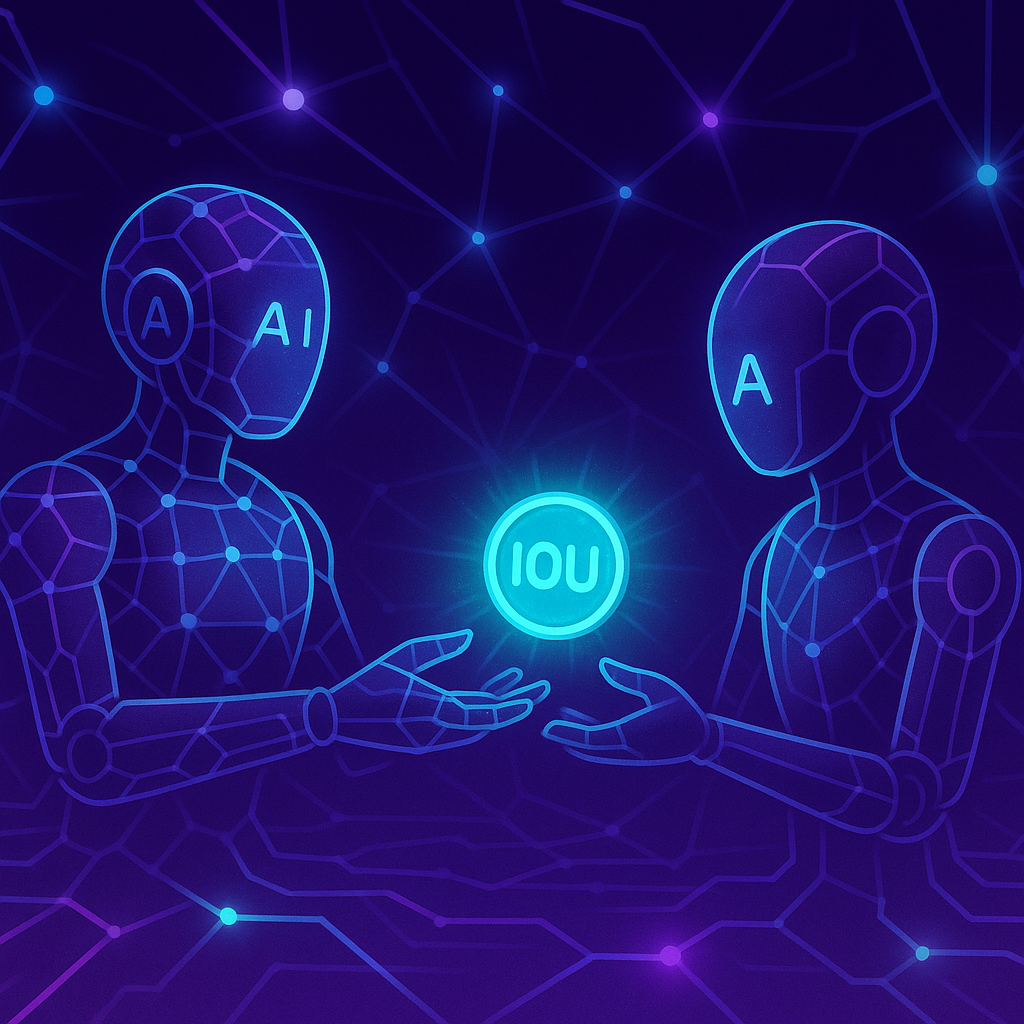
An agent-to-agent (A2A) payment is a financial settlement between an orchestrating AI agent and a specialist sub-agent it directed to complete a task. Unlike agent-to-merchant payments, A2A transactions have no human authorization per transaction, no external vendor, and require sub-cent economics that card rails cannot support. They are settled internally via IOU or micro-batch credit systems.
This distinction matters because the infrastructure requirements are fundamentally different. Building A2A payments on the same rails as agent-to-merchant payments is like routing internal corporate transfers through a consumer checkout flow. Technically possible. Economically broken.
Agent-to-Merchant vs Agent-to-Agent: Why They’re Different
Agent-to-merchant is the pattern everyone is building for. The agent has a credential (virtual card, token, wallet), a merchant has an endpoint, and the payment moves across an existing network. The human principal authorized the agent’s spending in advance; the card network handles settlement; the merchant gets paid.
Agent-to-agent breaks every assumption in that model.
| Dimension | Agent-to-Merchant | Agent-to-Agent |
|---|---|---|
| Who authorizes | Human principal | Orchestrating agent |
| Payment method | Card / token / crypto | IOU / internal credit |
| Trust anchor | Human identity | Agent identity chain |
| Settlement | Real-time | Micro-batch or IOU |
| Revocation | Per transaction | Per agent account |
The trust anchor difference is the deepest problem. In agent-to-merchant, a human identity — a PayPal account, a verified card — sits behind the transaction. The merchant trusts the network that vouches for the human. In agent-to-agent, there’s no human in the loop per transaction. The orchestrator is authorizing on behalf of a principal who set policy in advance. The trust chain is: human set policy → orchestrator executes → sub-agent gets compensated. No card network spans that chain.
Google’s A2A protocol announcement addresses the communication layer — how agents delegate tasks and return results (Google Cloud, 2025). It’s a necessary standard. But communication and payment are separate problems. A2A protocol tells the sub-agent what to do. Nothing in the protocol tells you how the orchestrator pays for the result.
Why Existing Payment Rails Break for A2A
Card networks are not the right tool here, and the math makes it obvious.
Card networks have a ~$0.30 per-transaction floor. That’s the interchange minimum — it’s structural, not negotiable. When a specialist sub-agent completes a data lookup worth $0.001 of compute, running that through a card network means the payment costs 300x more than the work. The a16z newsletter on agent payments flagged this structural problem directly: card economics break when transactions get small and frequent (a16z, 2025).
Crypto rails are better on per-transaction cost but create new problems: latency (even fast chains take seconds), gas fees on congested networks, and wallet management overhead for every sub-agent. Stripe launched Tempo in March 2026 — a stablecoin-native payments blockchain — specifically because existing rails don’t handle machine-to-machine micropayments (CoinDesk, March 2026). Tempo’s Machine Payments Protocol is designed for exactly this: software programs settling with other software programs without per-transaction human approval. But even Tempo is primarily targeting agent-to-merchant use cases.
The deeper issue is credential scope. Card credentials are issued to human principals and delegated to agents. For agent-to-agent payments, you’d need to issue credentials to agents that can themselves authorize sub-agent payments — a nested delegation model that no existing card issuer supports cleanly.
The IOU Token Model for Agent-to-Agent Settlements
The IOU token model solves A2A payment economics without requiring external rail support.
The core mechanism: the orchestrator holds a funded balance (ATXP credits, for example). When it delegates work to a sub-agent, it issues an IOU — an internal record of what the sub-agent is owed. The sub-agent completes the task. The IOU is redeemed against the orchestrator’s balance in a micro-batch settlement, not a real-time wire. No card network, no per-transaction fee, sub-cent granularity.
This is the same model corporate treasury uses internally. Departments don’t wire-transfer money for every interdepartmental request. They record debits, settle periodically, and keep the internal economy separated from the external payment layer. Agent account structure in a multi-agent system works the same way.
For a full breakdown of how IOU tokens compare to virtual cards and crypto, see the payment model options post.
The IOU model also handles revocation cleanly — a dimension where card rails struggle. If a sub-agent misbehaves or completes work outside spec, the orchestrator can revoke its IOU redemption rights without touching any external card or wallet. The credential is internal; revocation is internal.
Real A2A Examples: Orchestrators Paying Sub-Agents
Consider a research orchestrator that routes tasks to three specialist sub-agents: one for web search, one for document parsing, one for data synthesis. Each task takes milliseconds to seconds and costs fractions of a cent in compute. The orchestrator needs to track what each sub-agent did and compensate accordingly.
In a properly structured multi-agent system architecture, this looks like:
- Orchestrator receives user request and allocates a task budget (e.g., 500 ATXP credits)
- Orchestrator issues IOU authorizations to each sub-agent with per-task limits
- Sub-agents execute and return results with cost records
- Orchestrator validates results, settles IOUs against its balance
- Remaining balance returns to the principal’s account
This settlement cycle can run on every task completion, every minute, or at session end — the granularity is configurable because it’s internal. No card network determines the settlement cadence.
A more complex pattern involves sub-agents that themselves spin up sub-sub-agents. The credit chain extends: orchestrator funds the mid-tier agent; mid-tier issues IOUs to its workers. The top-level principal’s balance ultimately covers all of it, but the authorization chain is recorded at every level. This is what meaningful audit trails for agentic systems require.
How to Set Up A2A Payments Today
The honest answer is that no turnkey A2A payment infrastructure exists yet. What exists:
Internal IOU systems (what ATXP provides): Funded ATXP credit balance at the orchestrator level, with per-sub-agent spending limits and per-task cost recording. Settlement is internal; no card network involved. This works today for agent stacks running on ATXP infrastructure.
Stablecoin micro-batch settlement (emerging): Tempo and similar protocols will support machine-to-machine settlement at sub-cent granularity once ecosystem adoption grows. Not turnkey today.
Custom ledger (DIY): Build your own internal accounting layer between orchestrator and sub-agents. Viable for sophisticated teams. Significant engineering overhead.
The practical recommendation: use IOU tokens for internal A2A settlement now, and monitor stablecoin protocol adoption for external A2A scenarios where sub-agents are run by separate organizations.
As Kenny, ATXP co-founder, put it: “Software is now a buyer. This isn’t about monetizing humans more efficiently — it’s a new category of demand that didn’t exist before.” The A2A payment case is the clearest example: software buying from software, at scale, at sub-cent prices, with no human in the loop. The infrastructure has to be built for that reality.
FAQ
What is the difference between A2A communication protocols and A2A payment protocols? A2A communication protocols (like Google’s A2A) handle task delegation, capability discovery, and result handoff between agents. Payment protocols handle the financial settlement for that work. They’re complementary but separate. Most multi-agent frameworks have solved communication; payment settlement is still largely unsolved.
Can orchestrators use virtual cards to pay sub-agents? Technically, but it breaks economically. Virtual cards carry card network fees (~$0.30/transaction floor) that exceed the value of most sub-agent tasks. They also require issuing cards to agents that may themselves need to issue to further sub-agents — a delegation model card issuers don’t support.
How does ATXP handle agent-to-agent payment accounting? ATXP’s credit system allows an orchestrator to set per-sub-agent spending limits within a master account. Each sub-agent’s costs are tracked against its allocated sub-budget. The principal sees a single consolidated view; the internal accounting handles the A2A layer. No card network is involved in tool-call settlements.
What settlement cadence should A2A payments use? For internal sub-agents (same system, same trust boundary), micro-batch settlement at task completion works well. For external sub-agents (different organizations, different trust), per-task settlement via stablecoin or periodic IOU redemption with cryptographic verification is more appropriate. The cadence depends on trust boundary, not technical capability.