
AI Without the Subscription: Why Pay-Per-Use Wins
Most AI users experience bursty demand rather than consistent daily usage. Fixed monthly plans charge for idle periods as though work were uniform, creating unnecessary waste. The core issue isn’t that subscriptions are inherently problematic — task-based billing often provides a cleaner alternative for variable workloads.
What Usage Variance Actually Looks Like
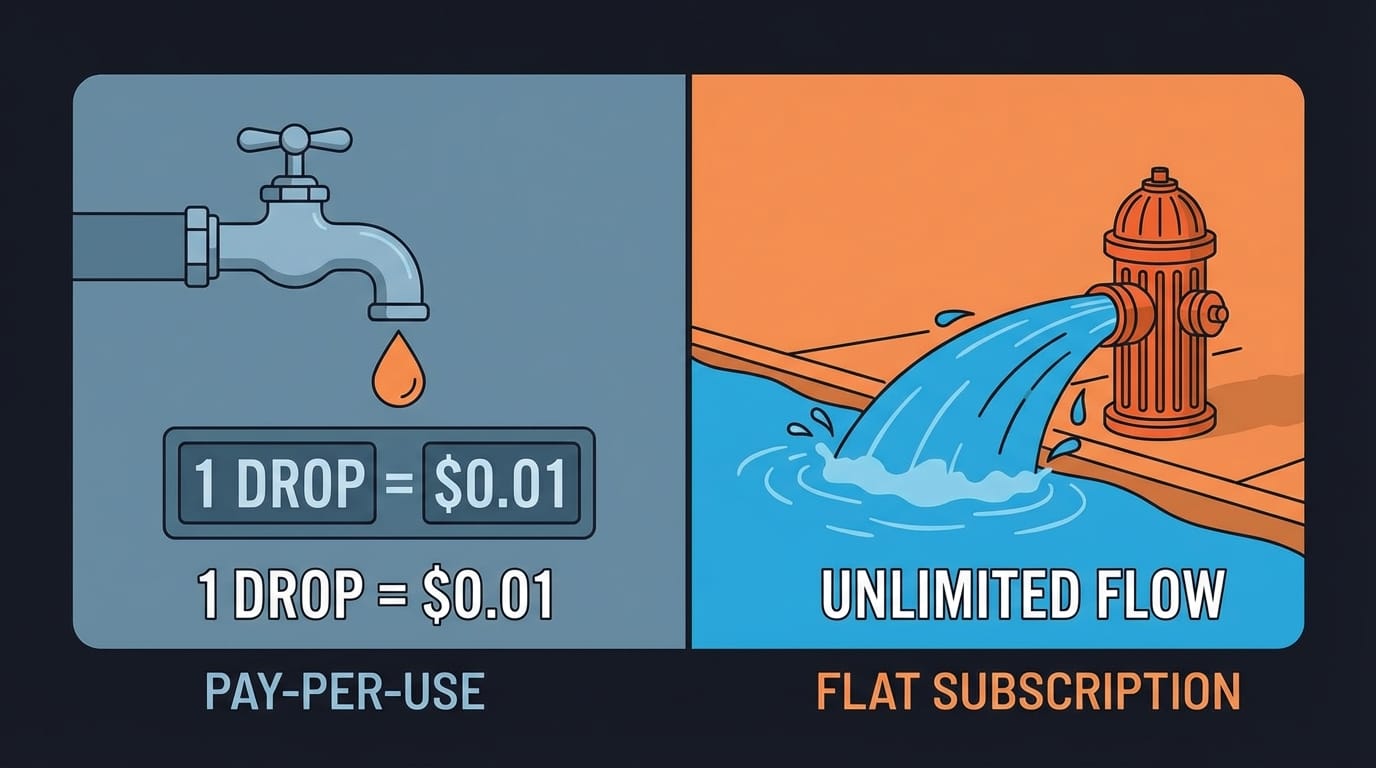
AI consumption fluctuates significantly by day, project, and workflow. A user might run intensive model sessions on weekends while skipping midweek usage entirely. Fixed plans treat irregular patterns as if they were constant, forcing payment for unused capacity.
What Pay-Per-Use Unlocks
Pay-per-use enables mixed routing — deploying smaller models for summarization and stronger models for compliance work. This creates alignment between cost decisions and task requirements. Subscription tiers often lock users into single quality levels, coupling economics to price brackets rather than outcomes.
Predictability Without Idle Charges
Predictability should come from caps, alerts, and monthly guardrails. It should not come from paying for unknown idle capacity. Transparent spending bands let users understand monthly expenses and adjust strategies accordingly.
The Simple Math
| Pattern | Subscription | Pay-per-use |
|---|---|---|
| 3 days use, 4 idle days | Full monthly fee | Charge for 3 days only |
| Mixed task complexity | Single plan tier | Lower models for simple tasks |
| Unexpected spike | Silent overpay | Visible alerts |
What to Compare Before Switching
Compare baseline minimums, overage behavior, and policy controls — not headline prices alone. The right architecture for consumer AI is usage-aware policy tied to tool calls, which keeps costs visible and reduces friction.
"I was shocked how cheap it actually is once you're routing efficiently. The agents that seemed expensive were the ones with unnecessary overhead, not the ones doing a lot of work."
 Louis Amira, co-founder, Circuit & Chisel
Pay-per-use AI billing charges for each individual model call, tool invocation, or token consumed — rather than a flat monthly subscription fee. It aligns cost directly with consumption, enables mixed routing across models of different capability and price, and eliminates idle charges during periods of low or no usage.
npx atxpGive your agent pay-per-use billing with no monthly minimums — only pay for what it actually does. How LLM token pricing works → · Pay-per-use agent commerce →
Frequently asked questions
Why is pay-per-use better than a subscription for AI?
Most AI users have bursty demand — intensive sessions some days, nothing on others. Subscriptions charge a flat fee regardless of usage, meaning you pay for idle time. Pay-per-use charges only for what you actually consume, which is almost always cheaper for variable workloads.
Can I get predictable monthly spending with pay-per-use?
Yes. Predictability comes from caps and alerts, not from paying for unknown idle capacity. A hard monthly cap gives you a spending ceiling; transparent per-use billing shows exactly where money is going.
Is pay-per-use only for power users or heavy AI consumers?
No — mixed-usage households and teams with uneven demand benefit most. If your AI usage fluctuates significantly day-to-day or week-to-week, pay-per-use will almost always save money compared to a fixed tier.
Does pay-per-use allow routing to different models for different tasks?
Yes, and this is one of the key advantages. Pay-per-use enables mixed routing — cheaper models for simple summarization, more capable models for complex compliance work. Subscriptions typically lock you into a single quality tier.
What should I compare when evaluating pay-per-use versus subscriptions?
Compare baseline minimums, overage behavior, and policy controls — not headline prices alone. A subscription with poor overage handling can surprise you with large bills; a pay-per-use plan with no spending caps can do the same.