
Pay-Per-Use Is the Natural Equilibrium for Agent Commerce
Right now, somewhere, a developer is paying $20 a month for a tool their agent used twice last month. The month before, it didn’t use that tool at all. Next month, it might use it 300 times in a single afternoon — then go quiet again.
The developer is paying $20 a month anyway. Because that’s how the contract works.
This is not a billing quirk. It’s a structural mismatch between a pricing model designed for human behavior and a world where software is increasingly the customer. The subscription model assumes you use something steadily, every month, in rough proportion to what you’re paying for. AI agents don’t do that. They never will. And yet the entire stack that developers are building on — API access, tool libraries, compute platforms — still defaults to subscription pricing that dates from a world where the user was a person with a work calendar.
The equilibrium is shifting. Here’s why pay-per-use is where it ends up.

How Software Got Addicted to Subscriptions
Pay-per-use AI is a billing model in which you pay only for the compute, tool calls, or API requests your agent actually makes — no monthly seat fee, no subscription to maintain, no minimum spend. If your agent makes 10 tool calls this month and zero next month, you pay for 10 calls and nothing else. The price is tied directly to the value delivered, not to time elapsed — making it the only model that correctly prices agent workloads with variable, burst-driven usage patterns.
Subscriptions made sense when the user was a human and humans are predictable.
A person using a project management tool logs in most workdays, roughly every month. A team paying for a CRM uses it every week. The subscription model worked because the relationship between a human user and a software product is, by nature, roughly consistent over time. Humans budget monthly. They get paid monthly. They think about costs monthly. A $20 bill that recurs on the first of the month is easy to plan around and easy to cancel.
Software vendors loved it for the opposite reason: predictable, recurring revenue is worth far more to a business than lumpy, per-use revenue. Subscription SaaS multiples rewarded the model. Every product category eventually moved toward it — from project management to email to databases to API access. By 2024, the average developer maintaining an agent-capable stack was paying $80–200 per month in subscriptions across AWS, Anthropic, OpenAI, and three to five additional service APIs — regardless of whether their workload justified the spend.
“We have a Slack subscription, a HubSpot subscription, whatever else. We think that that’s kind of nuts. You should only pay for stuff you use moving forward, which obviously changes a bunch of SaaS models.”
— Louis Amira, co-founder, ATXP
The model is deeply entrenched. It is also wrong for agents.
Why Subscriptions Break When Software Is the Customer
Pay-per-use AI is a billing model in which you pay only for the compute, tool calls, or API requests your agent actually makes — no monthly seat fee, no minimum commitment, no subscription to maintain. If your agent makes 10 tool calls this month and zero next month, you pay for 10 calls and nothing else. The price is tied directly to the value delivered, not to time elapsed.
This definition matters because it’s not just a pricing preference. It’s the only model that reflects how agents actually consume services.
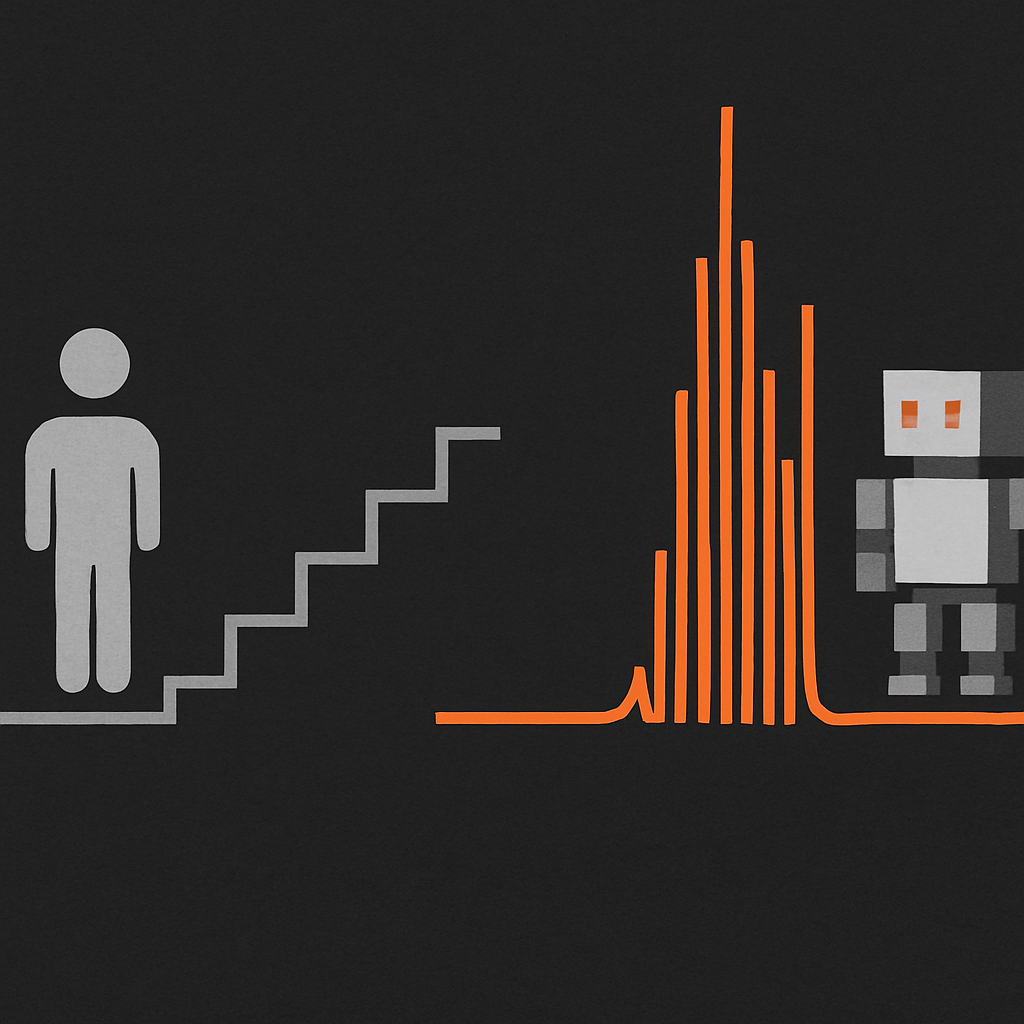
Agents don’t work on human schedules. A research agent might sit idle for three weeks, then execute 2,000 web searches and 400 document reads in a single afternoon. A commerce agent might process zero transactions in January and 800 in the week before a product launch. A coding agent fires intensely during a sprint and goes dormant between them. These are not aberrations — they are the natural usage patterns of software that operates on workload demand, not human routine.
Subscriptions priced for human-pace usage punish this behavior in two directions simultaneously. During idle periods, you pay for nothing. During burst periods, your subscription tier might rate-limit the agent anyway, forcing an upgrade. You end up optimizing your subscription tier for peak usage — which means you’re dramatically overpaying during normal usage.
The math is not ambiguous. If your agent makes 50 tool calls a month at $0.01 per call, you pay $0.50. Under a typical subscription model for the same tool category, you pay $20 or more — whether you make 50 calls or 5,000. At 50 calls, the subscription charges 40 times the actual cost. At 5,000 calls, the economics finally flip in the subscription’s favor — but only if your agent consistently operates at that scale, which few do.
The subscription model was not designed to be exploitative. It was designed around a user type that no longer dominates consumption. The user type has changed.
"Everyone in the subscription space has always known that business model is great — it preys on the large number of users who don't spend the full balance, and those people subsidize the power users who get more than they bargained for. Pay-per-use is a much cleaner way for all parties to operate. Unfortunately, that wasn't possible until crypto and stablecoins emerged — transaction fees made it complicated for anyone selling a lower dollar value subscription."
 Louis Amira — Co-founder, ATXP
What Pay-Per-Use Actually Means for Agents
The shift isn’t only about cost savings for individual developers. The deeper change is structural: when agents become the customers, the demand patterns for software services transform entirely.
Stripe’s 2025 agentic commerce letter identified something important about this moment. The move from human buyers to agent buyers isn’t just an interface change — it creates entirely new demand. Once pricing is per-call, per-outcome, or per-completed-task, software can be monetized by a customer class that didn’t exist before. As ATXP’s analysis of that letter put it: “You don’t just monetize humans more efficiently. You get brand new demand from software that can pay.”
That framing matters. The addressable market for a tool that sells subscriptions to humans is bounded by the number of humans willing to pay. The addressable market for a tool that sells per-call access to agents is bounded by the number of tasks those agents execute — which, at 46.3% CAGR (IDC’s projection for the AI agent market through 2030), is growing faster than the human subscriber base ever did.
Agents also make purchase decisions differently than humans. A human might stick with an expensive subscription out of inertia, because switching is annoying, or because the finance team already approved it. An agent — or the system managing its spending — can and will recalculate price-to-performance at every tool call. Louis describes this vision directly: “I expect over time you will basically just run a calculation or your agent will run a calculation saying like give me the best price per performance per price thing out there. I don’t actually really care which model it is.”
That kind of rational, per-call optimization is only possible when pricing is per-call. Under subscriptions, there’s no meaningful optimization signal. You’re locked in.

The Math That Changes
| Scenario | Subscription cost / month | Pay-per-use cost / month | Difference |
|---|---|---|---|
| Agent makes 50 tool calls at $0.01/call | $20+ (typical tier) | $0.50 | Subscription costs 40x more |
| Agent makes 500 tool calls at $0.01/call | $20+ (same tier) | $5.00 | Subscription costs 4x more |
| Agent makes 2,000 tool calls at $0.01/call | $20–50 (may need upgrade) | $20.00 | Break-even |
| Agent makes 5,000 calls across 4 services | $80–200 (four subscriptions) | $50.00 | Subscription costs 1.6–4x more |
| Agent is idle for 3 weeks, bursts 1 week | $20+ regardless | Cost only for burst week | Subscription captures idle weeks |
The AI agent market is projected to grow from $7.84 billion in 2025 to $52.62 billion by 2030 — a 46.3% compound annual growth rate (IDC). Gartner projects enterprise agent adoption moving from under 5% in 2025 to 40% by 2026. As that adoption curve steepens, the aggregate cost of subscription-model overhead becomes significant — not just annoying.
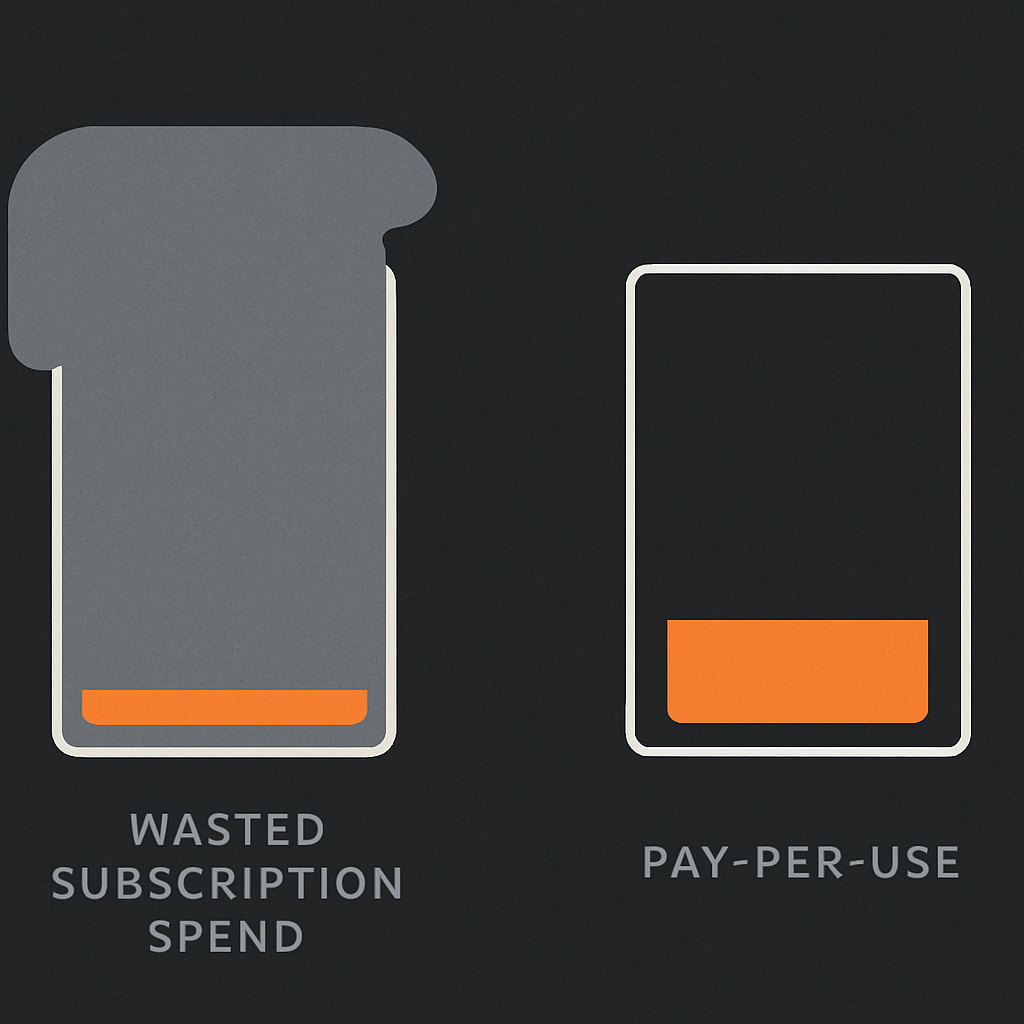
A developer managing a typical agent stack today pays $80–200 per month in combined subscriptions across AWS plus four AI service APIs. Much of that spend is for access, not for usage. The developer is paying to have the option to use these services, not to use them. When the agent does actually run, the per-unit cost of what it consumes is often a small fraction of the subscription floor.
Pay-per-use eliminates the floor. You pay for what runs. Nothing else.
"People are able to hop between different tools and models without keeping mental track of 'did I get $20 or $200 worth of value out of this tool this month?' Some users spend hundreds of dollars a month across all sorts of tools — knowing which models are best for each use case, keeping all of the context and workflow in one spot. Their agent would prefer to navigate one place instead of having to hop store to store."
Louis Amira — Co-founder, ATXP
What Comes Next
The direction is clear enough to state plainly: subscription pricing for AI services is a transitional artifact. It will persist for a while — incumbents have built their revenue models around it, and switching costs are real — but it is not the equilibrium.
The equilibrium is per-call, per-outcome, per-delivered-value pricing. Not because it’s philosophically superior, but because it’s the only model that aligns incentives when the buyer is software. Agents don’t need budgets. They don’t need to spread cost across a month. They don’t have cognitive overhead around “am I getting my money’s worth?” They have a task, a tool, and a cost. Pay the cost, complete the task.
The infrastructure question is where this gets concrete. Per-call billing requires an identity layer — the agent needs an account that can hold a balance, make requests, and pay per call without human involvement at each step. It requires a payment layer that can settle micropayments at machine speed, without credit card overhead per transaction. It requires that tools and models be available without each one requiring a separate account, separate API key, and separate subscription. This is not a trivial stack.
Louis’s five-year vision for this: “There are no subscriptions anymore. Or it is confusing to figure out what you would subscribe to. The cost to transact has fallen pretty close to the cost of electricity.”
insane thing: we are currently losing money on openai pro subscriptions! people use it much more than we expected.
— Sam Altman (@sama) January 2025
That’s the endpoint. The friction isn’t the pricing model — it’s the infrastructure. Once agents can transact autonomously, with their own balances, across any tool they need, without human involvement per call, the subscription model has no structural advantage left to offer them.
ATXP gives agents the infrastructure for this today: a persistent agent handle, a pre-funded IOU balance that deducts per tool call, an @atxp.email address, and access to 14+ tools — all in one account, no API keys, no subscriptions. New models appear automatically; the agent can pick the best price-to-performance ratio without any human reconfiguration.
npx atxpThat installs the ATXP skill in your agent. Ten free IOU tokens on registration. Pay per call only. Here’s what this looks like in practice →
Subscription pricing wasn’t wrong. It was designed for the user type that existed when it was designed. Humans with monthly budgets, monthly paychecks, and monthly cognitive cycles for evaluating what they spend on software. It made sense. It worked.
Agents are not humans with monthly budgets. They are workload-driven, burst-prone, price-rational at the per-call level, and increasingly the dominant consumer of AI services. The pricing model that fits them is not the one we inherited from the SaaS era. The equilibrium is pay-per-use — not as a feature, but as the only model that correctly prices value when usage is driven by agent workloads instead of human calendars.
The companies that figure this out early — on both the selling and buying side — will have a structural advantage over those still paying $20 a month for tools their agents used twice.
"There is a massive world of very small transactions that have never been economically viable. Agents are going to do a lot more of them than humans ever would have worried about. Many people won't stop and pick up a penny on the sidewalk. Agents will pick up every penny they see and save it — because they have all the time in the world."
Louis Amira — Co-founder, ATXP
Frequently asked questions
What is pay-per-use AI?
Pay-per-use AI means you pay only for the compute, tool calls, or API requests your agent actually makes — nothing more. There is no monthly seat fee, no subscription to maintain, no minimum spend. If your agent makes 10 tool calls this month and zero next month, you pay for 10 calls and nothing else.
Why do subscriptions fail for AI agents?
Subscriptions were designed for predictable, human-paced usage — a person logging in daily, consuming roughly the same amount each month. Agents don’t work that way. They burst during active jobs, sit completely idle between tasks, and their workloads are driven by what the software needs, not by a human calendar. A $20/month subscription for a tool your agent uses twice is economically irrational.
What is pay-as-you-go vs. subscription for AI tools?
A subscription charges a fixed monthly fee regardless of usage. Pay-as-you-go charges only for actual usage — per call, per request, per token consumed. For human users with steady usage patterns, subscriptions can be a fair deal. For AI agents with variable, burst-driven workloads, pay-as-you-go is almost always cheaper and better aligned with how the work actually happens.
What are IOU tokens in agent payments?
IOU tokens are pre-funded credits that deduct from an agent’s balance each time it makes a tool call. The agent holds a balance; each tool call costs a defined amount; no human approval is needed per transaction. ATXP uses this model. It lets agents pay for things autonomously without requiring a credit card per call, a human in the loop, or a monthly subscription to maintain.
Will all AI services move to pay-per-use?
The direction is clear. As agents become the primary consumers of AI services — not humans — pricing will have to align with how agents actually consume: in variable bursts, autonomously, at machine speed. Services that don’t offer per-call billing will lose agent customers to those that do. The shift is already happening at the infrastructure layer, led by API pricing models.
How does ATXP handle per-call billing?
ATXP uses an IOU-based pay-as-you-go model. An agent’s account is pre-funded; each tool call deducts from the balance at the actual cost of the underlying API, with no markup. No subscriptions, no monthly minimums, no per-service API keys to manage. New models and tools appear on ATXP automatically — the agent can compare price-to-performance and pick the best option without any human reconfiguration.
The infrastructure for per-call billing exists now. The pricing model that matches how agents actually work is available now. The question isn’t whether pay-per-use wins — it’s whether you get there before you’ve spent another year paying subscription floors on tools your agent uses twice a month.
If you’re running an agent today: understand what your agent actually needs to function →. If you’re evaluating payment infrastructure options: see how the agent payment protocols compare →. If you’re ready to move off subscriptions entirely: npx atxp — and your agent gets identity, payments, email, and 14+ tools in one pay-as-you-go account. Why the current stack is missing a foundational layer →