
How Much Does an AI Agent Cost? A Honest 2026 Breakdown
The question “how much does an AI agent cost” has four very different answers depending on how you build. The honest version covers all four — and points out the costs that don’t show up in the headline price.
The short answer
AI agent costs in 2026 range from $0 to several hundred dollars per month. Subscription products (ChatGPT Plus, Claude Pro) run $20–25/month each regardless of usage. DIY builds with separate API keys typically run $50–200/month in combined API spend. ATXP’s pay-as-you-go model starts free and costs only what your agent actually uses — typically under $5/month for light use, scaling with actual activity.
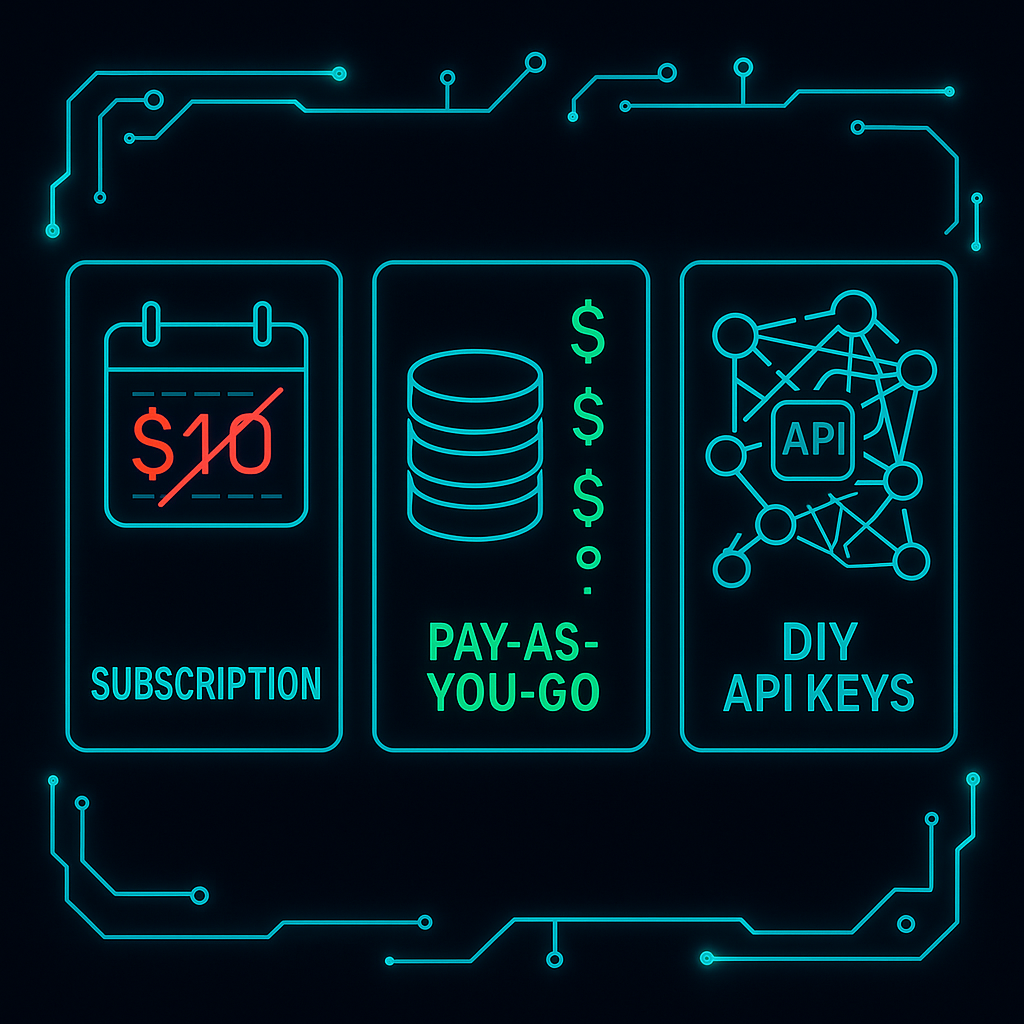
The four cost models
| Model | How it’s billed | Good for | Watch out for |
|---|---|---|---|
| Subscription (all-in-one) | Fixed monthly, e.g. $20/mo | Predictable budgets, heavy daily users | Paying full price whether you use it or not |
| Pay-per-use | Per tool call / per token | Variable usage, cost-conscious users | None significant — this is the honest model |
| DIY API stack | Per token × 7+ providers | Maximum control and flexibility | Management overhead, fragmented billing |
| Enterprise contracts | Seat-based or usage + minimum | Large teams, SLA requirements | Minimums that don’t match actual usage |
Most users aren’t heavy enough to justify a subscription. Most developers don’t want to manage seven API keys. Pay-per-use sits between those extremes.
Component 1: LLM costs
Pay-per-use AI pricing charges only for what an agent actually uses — per token for LLM inference, per call for tool actions — with no monthly floor, no subscription minimum, and no idle cost. Unlike subscription pricing (which charges the same whether the agent ran 5 times or 5,000), pay-per-use matches cost directly to activity, making it the economically correct model for agent workloads with variable, burst-driven usage.
Every agent call involves the LLM deciding what to do. LLMs charge per token — a unit roughly equal to 0.75 words. Input tokens (what you send the model) cost less than output tokens (what it returns).
Current LLM API pricing (early 2026):
| Model | Input (per 1M tokens) | Output (per 1M tokens) | Best for |
|---|---|---|---|
| Claude claude-3-7-sonnet-latest | ~$3.00 | ~$15.00 | Complex reasoning, long tasks |
| GPT-4o | ~$2.50 | ~$10.00 | General-purpose tasks |
| Gemini 1.5 Pro | ~$1.25 | ~$5.00 | Cost-sensitive, high-volume |
| Claude Haiku | ~$0.25 | ~$1.25 | Fast, simple tasks |
| GPT-4o mini | ~$0.15 | ~$0.60 | Simple classification, routing |
A typical agent task — a research query, a code generation request, a data transformation — uses somewhere between 2,000 and 10,000 tokens total. At Claude Sonnet rates, that’s $0.006 to $0.06 per task. At GPT-4o rates, similar. LLM costs alone are rarely the expensive part.
The expensive part is context: long documents, large codebases, multi-turn conversations with heavy history. If your agent is repeatedly sending a 50,000-token context window to a top-tier model, costs compound fast. The full breakdown of how token pricing works → covers compounding context costs in detail.
Component 2: Tool costs
Tools are what make agents act rather than just talk. Each tool call has a cost.
Typical tool call costs (per call):
| Tool | Approximate cost | Notes |
|---|---|---|
| Web search | $0.002–0.005 | Per query |
| Web browsing | $0.005–0.02 | Per page fetched and processed |
| Code execution | $0.01–0.05 | Per sandbox run, varies by complexity |
| Image generation | $0.02–0.08 | Per image, varies by resolution |
| Email send | $0.001–0.005 | Per message |
| File operations | <$0.001 | Per operation |
For most agent tasks, tool costs are measured in cents. A research task that runs 5 web searches and reads 3 pages costs roughly $0.04 in tool calls — before LLM costs.
Where tool costs escalate: high-volume monitoring (checking 100 competitor pages daily), image generation at scale, or code execution for compute-heavy jobs. These are the use cases where monitoring your agent’s spend dashboard matters.
Component 3: Infrastructure costs
This is the layer most cost comparisons skip — and it’s where the real cost difference lies between building yourself and using ATXP.
A capable agent needs:
- Identity management — a persistent handle, session management, authentication
- Payment routing — a pre-funded account, transaction processing, spend controls
- Email — a dedicated address, inbox management, send/receive infrastructure
Managing this yourself means integrating multiple providers, managing multiple billing relationships, and spending engineering time on infrastructure instead of your actual product.
ATXP bundles all of this into one account. The identity, payment account, and email address come with the agent — you don’t provision them separately or pay for them separately.
Component 4: The hidden cost — management overhead
This is the cost that doesn’t show up on invoices but shows up in engineering time.
"Most developers hate managing API keys — Stripe built an entire culture around making clean, ergonomic ones and developers still complain. When you multiply that by seven providers, suddenly someone on your team is spending real hours every month on credential rotation, billing reconciliation, and debugging rate limits that vary across every provider."
 Louis Amira — Co-founder, ATXP
A realistic estimate of DIY management overhead for a production agent stack with 7 API providers:
| Task | Time per month |
|---|---|
| Credential rotation and expiry management | 1–2 hours |
| Billing reconciliation across providers | 1–2 hours |
| Debugging rate limit and quota issues | 1–3 hours |
| Monitoring spend across fragmented dashboards | 30 min–1 hour |
| Total | 3.5–8 hours |
At a fully-loaded engineering rate of $100/hour, that’s $350–800/month in management overhead that never appears on your API invoice. ATXP consolidates to one account, one billing surface, and one dashboard — that overhead disappears.
What you actually pay with ATXP
ATXP’s pricing model is pay-per-use. No subscription. No minimum.
On registration: 10 free IOU tokens — no credit card required.
After free tokens: You add IOU credit and spend per tool call. Most tasks cost fractions of a cent for infrastructure; the LLM cost varies by model and context length.
Light user (a few research tasks or automations per week): typically under $5/month total.
Heavy user (daily automations, monitoring pipelines, multi-step commerce tasks): scales with actual usage — you see the per-call costs and control the cap.
Spend cap by design: The IOU model means the agent can never spend more than what’s pre-funded. You set the ceiling; the agent operates within it. No surprise invoices.
# Get started — 10 free tokens, no credit card
npx atxp
Subscription vs. pay-per-use: the math
The break-even point between a $20/month subscription and pay-per-use depends on how much you use it.
| Usage level | Subscription cost | Pay-per-use cost | Winner |
|---|---|---|---|
| Occasional (few tasks/week) | $20 | $2–5 | Pay-per-use |
| Moderate (daily tasks) | $20 | $8–15 | Pay-per-use or break-even |
| Heavy (dozens of tasks/day) | $20 | $20–40+ | Subscription (if included) |
| Variable (bursty usage) | $20 every month | Pay for burst only | Pay-per-use |
"People are able to hop between different tools and models without keeping mental track of what they're paying for each one. The cost is always visible, always predictable — because it's tied to actual usage, not to a subscription you set up and forgot about."
Louis Amira — Co-founder, ATXP
Subscriptions make sense when you consistently use 100% of the included capacity every month. For most users — and almost all agent workflows — usage is variable. Pay-per-use charges for that variability accurately. Subscriptions don’t.
The full cost picture
| Cost component | Subscription | DIY API stack | ATXP pay-per-use |
|---|---|---|---|
| Monthly base | $20–25/mo | $0 | $0 |
| LLM API | Included | $20–100+/mo | Per token |
| Tool calls | Limited/included | $10–50+/mo per provider | Per call |
| Identity + email + payments | Not included | DIY cost | Included |
| Management overhead | Low | High | None |
| Free start | Sometimes | No | Yes (10 tokens) |
| Spend caps | Set by provider | Manual per-provider | Built-in by design |
The total cost of ownership usually favors ATXP for any usage pattern that isn’t “maxing out a subscription every single day.” The free start and built-in spend controls eliminate the two most common friction points: commitment before you know if it’s useful, and surprise charges when an agent runs more than expected.
For a deeper look at how LLM token costs work and where they compound: how LLM token pricing works →
Frequently asked questions
How much does an AI agent cost?
It depends on the model. Subscriptions run $20–25/month regardless of usage. DIY API builds typically run $50–200/month in combined spend plus management overhead. ATXP pay-per-use starts free (10 tokens on registration) and costs only what your agent actually uses — typically under $5/month for light use.
What is the cheapest way to get an AI agent?
Start with atxp.chat — free, no credit card. Register for a free ATXP account and use the 10 included IOU tokens. After that, pay per tool call only. How to get an AI agent →
What drives AI agent costs?
Four components: LLM API calls (per token), tool calls (per action), infrastructure (identity, email, payments), and management overhead (engineering time for DIY stacks). Most cost estimates only cover the first two.
Why is pay-per-use cheaper than subscriptions for most users?
Subscriptions charge the same whether you use the full capacity or not. Pay-per-use charges only for actual usage. The math favors subscriptions only if you consistently max out the included usage every month — which most users don’t.
How much do LLM API calls cost?
A typical agent task (2,000–10,000 tokens) costs $0.006–0.06 at Claude Sonnet rates. The expensive case is large context windows reused across many calls. Full token pricing breakdown →
Are there hidden costs in building an AI agent?
Yes — management overhead is the most underestimated. Managing 7+ API providers, rotating credentials, reconciling billing, and debugging rate limits typically adds 3–8 hours of engineering time per month to a DIY stack. How to build an agent without API keys →