
Every Agent Payment Protocol Compared: x402, AP2, ACP, UCP, and ATXP
Which payment protocol layer should you implement first? Rather than offering a single answer, this post maps three distinct layers — each with different fault domains — that work best when composed together.

Quick Protocol Comparison
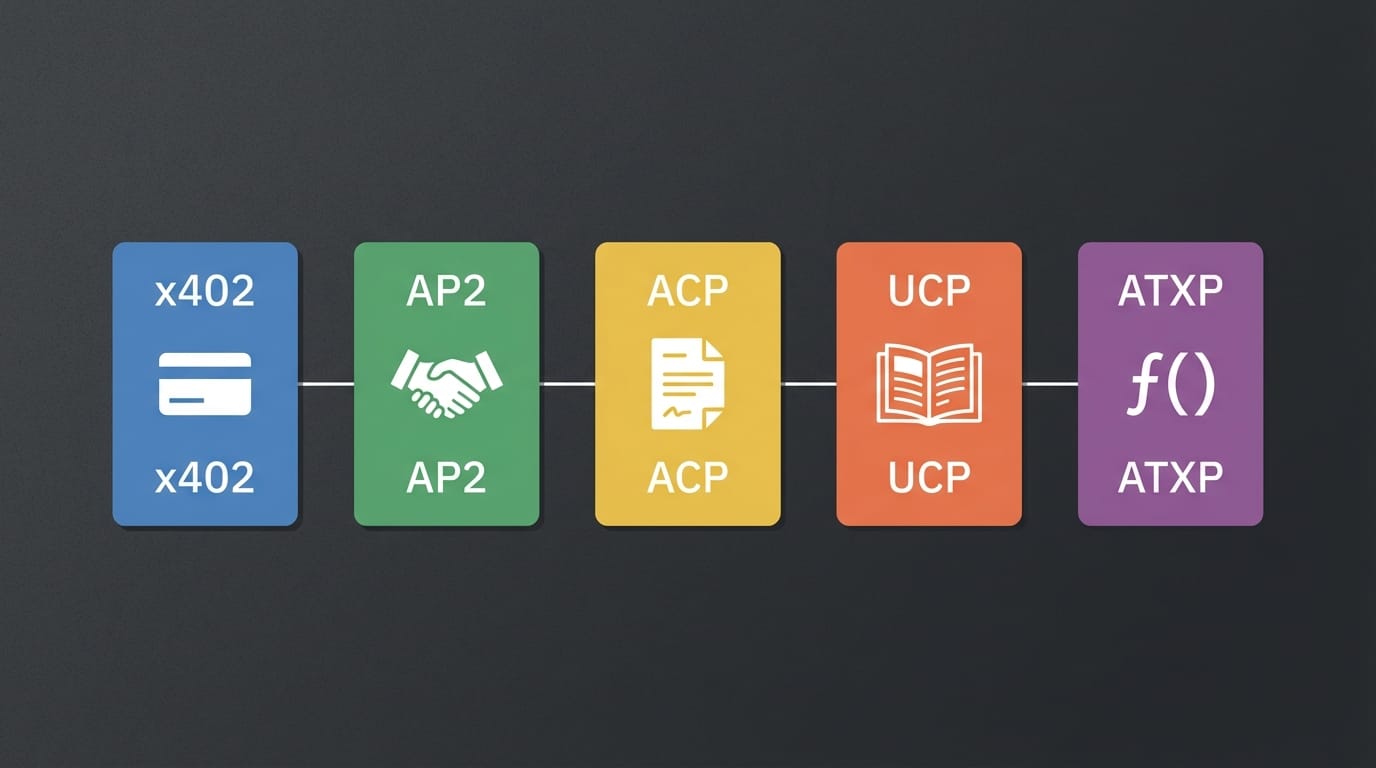
| Protocol | Primary Layer | Problem Solved | Ideal Use | Poor Fit |
|---|---|---|---|---|
| x402 | HTTP request billing | Per-request payment authorization | API services with stable semantics | Function-specific pricing across MCP tools |
| AP2 | Agent capability + task delegation | Cross-agent discovery and authorization | Multi-agent workflows | Detailed metered billing |
| ACP | Agent-to-agent coordination | Capability exchange and trust | Cross-vendor ecosystems | Commercial settlement and runtime wallets |
| UCP | Agent usage contracts | Unified accounting for use cases | Protocol-level policy requirements | Immediate narrow MCP deployments |
| ATXP | Function-level tool billing | Tool pricing and spend controls | MCP ecosystems and usage-based infrastructure | Pure transport or identity layers |
Key Insights
MCP tools and pricing. MCP tools carry richer semantic information than generic REST requests. Treating pricing as a native tool attribute — rather than an external billing wrapper — provides practical advantages.
Combining protocols. AP2 and ATXP work well together when workflows require both authorization and cost control. Keep them separate for single-agent MVPs that don’t yet need capability negotiation.
Governance vs. immediate needs. ACP and UCP serve interoperability policy, but they don’t directly solve pricing predictability challenges. Use governance frameworks when multi-partner architectures demand protocol-level contracts; prioritize ATXP when defining reliable price models matters most.
On running x402 without Layer 0 identity: ATXP co-founder Louis Amira on what developers hit when they try to wire x402 directly:
"You need a wallet and funds for any of the X402 services to work. We provision a wallet and can get you into the right currency and blockchain that support X402, but it's not entirely clear what's going to work — or not — until you try. And sometimes that confuses people because they don't know where to look or what went wrong."
 Louis Amira — Co-founder, ATXP
Recommended Implementation Path
- Tag each MCP tool with deterministic usage pricing metadata
- Introduce ATXP wrappers and enforce pre-call billing
- Integrate x402 or wallet rails for settlement
- Add AP2 for multi-agent task exchange
- Layer ACP/UCP contracts as cross-organization interoperability becomes critical
A fault domain in agent payment architecture is the layer at which a failure occurs and the scope of damage it can cause. x402 failures affect request routing. AP2 failures affect agent capability negotiation. ATXP failures affect tool billing. Separating these into distinct protocol layers means a failure in one domain doesn't cascade into another.
npx atxpOne account for all agent tool calls. Three payment models compared → · IOU token spending limits → · Virtual cards vs IOU tokens →
FAQ
x402 vs. ATXP — what’s the difference? x402 handles request-level semantics; ATXP targets function-level tool billing. They operate at different layers and can coexist.
Does ATXP depend on AP2? No. ATXP operates independently of AP2. Add AP2 when you need multi-agent capability negotiation.
Are ACP and UCP billing tools? No. They function as coordination frameworks rather than pricing engines. Use them for cross-organization interoperability, not transaction settlement.
Starting a public tool marketplace? Begin with tool price contracts and ATXP wrappers, then scale wallet rails and capability discovery per user demand.