
How Agents Pay for API Calls (And Why It's Different From How You Do)
When an AI agent calls a paid API — a web search, an image generation, a database query — something has to pay. In most setups today, that something is the developer’s account, billed silently against their personal API key. That works for demos. It’s the wrong model for production.
Here’s how agent payments actually work — and what the right model looks like.
The short answer
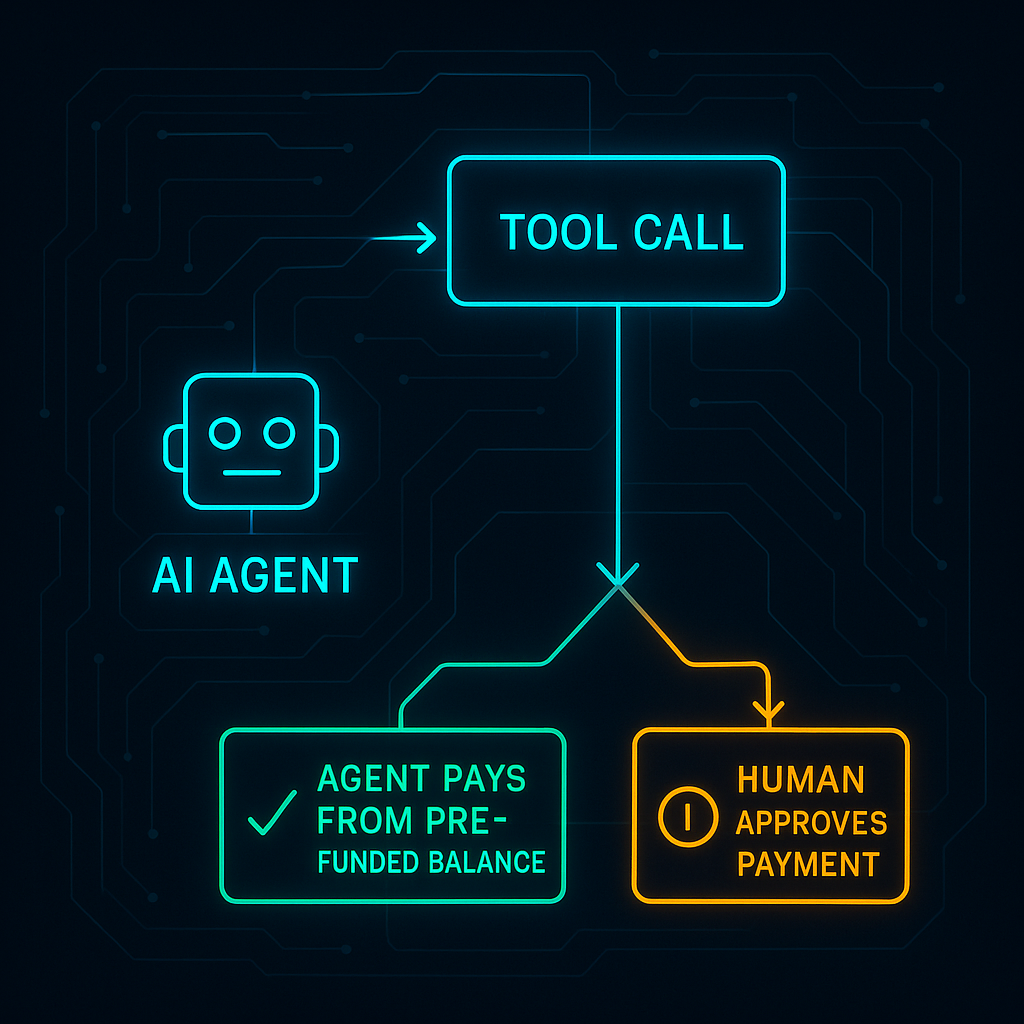
When an agent calls a paid API today, one of three things happens: (1) it uses the developer’s API key and charges their account, (2) it spends from a pre-funded payment account it owns, or (3) it uses a crypto wallet for on-chain payment. Option 1 is the default. Options 2 and 3 are the architecturally correct models for autonomous agents. ATXP implements option 2.
How most agents pay for API calls today
A pre-funded agent payment account is a balance that belongs to the agent, not the developer. The developer loads it with funds; the agent spends from it per API call or tool use. The agent can never exceed the pre-funded amount — the ceiling is structural, not a configurable rule. This creates per-agent spending accountability, eliminates shared-credential blast radius, and enables clean revocation without affecting the developer's own credentials.
The path of least resistance: give the agent an API key that belongs to the developer. The agent calls the API, the provider bills the developer’s account, and the developer reconciles the charge at the end of the month.
This works. It also creates several problems that compound as the agent matures:
No per-agent ceiling. The API key has a limit (your account’s overall limit), not a per-agent limit. If the agent runs more than expected, it runs up your bill — potentially past limits you’d have set if you were thinking about it.
No accountability separation. Your billing dashboard shows one account. Your activity and the agent’s activity are mixed. When you try to understand what a particular agent is spending, you’re filtering through your own usage.
Blast radius extends to you. A bug that causes the agent to make 10,000 calls instead of 10 exhausts your credits or triggers rate limits — affecting you, not just the agent.
No clean revocation. If you want to stop the agent from calling an API, you have to rotate the key — which may break other things that depend on it.
“The agents we were working with in late 2024 were obviously on the right track — but they needed to use my account for everything. Nothing like the economic actors we envisioned — I stress both words independently.”
— Louis Amira, Co-founder, ATXP
The phrase “economic actors” is precise. An actor that borrows someone else’s credentials isn’t an independent economic entity — it’s a proxy that happens to have API access. Genuine agent autonomy requires genuine agent financial independence.
How agents should pay for API calls
Three models are emerging for agent-native payment. They differ in mechanism but share a design principle: the agent has its own financial account, separate from the developer’s.
Model 1: Pre-funded IOU balance (ATXP)
The developer loads a balance into the agent’s account using ATXP IOU tokens. The agent spends from that balance per API call. The balance belongs to the agent — not the developer’s credit card, not the developer’s API account.
How it works at call time:
- Agent decides to call a tool (web search, image generation, etc.)
- ATXP checks the agent’s balance before the call executes
- If balance is sufficient: call executes, balance decrements
- If balance is insufficient: call fails gracefully, agent knows why
- Developer sees the transaction in the agent’s dashboard
The ceiling is structural: the agent literally cannot spend more than what’s loaded. No surprise invoices. No calls to billing support explaining what your agent did at 3am.
Model 2: Crypto wallet / on-chain micropayments
The agent holds a crypto wallet (USDC, ETH, or a stablecoin) and pays for API calls via on-chain transactions. Several protocols support this — x402 is the most notable for HTTP-level payment at the API request layer.
This model enables true micropayments: fractions of a cent per call that were economically unviable under traditional payment infrastructure. At $0.001 per web search query, the transaction fee on a credit card would exceed the payment itself. On-chain, the marginal cost of a tiny payment is near zero.
ATXP can provision and fund the agent’s wallet for x402-enabled APIs, handling the wallet management so the agent can complete payment challenges without the developer manually managing on-chain infrastructure.
Model 3: Virtual card per agent
Some teams provision a virtual payment card per agent (via Stripe Issuing, Lithic, or similar) and set per-card spend limits. The agent uses the card details for API billing. The card has a programmable limit; when it’s hit, the card declines automatically.
This is a reasonable interim model but has limitations: virtual cards are designed for human-initiated transactions, not sub-cent automated API calls; they add another provisioning step per agent; and they don’t solve the identity layer (the card is a billing instrument, not an identity).
What changes when the agent has its own payment account
| Agent borrows developer credentials | Agent has own payment account | |
|---|---|---|
| Spend ceiling | Developer’s overall limit | Pre-funded balance (structural) |
| Billing visibility | Mixed with developer activity | Per-agent dashboard |
| Blast radius | Developer account | Agent account only |
| Revocation | Rotate developer key (affects everything) | Revoke agent account (targeted) |
| Micropayments | Limited by card minimum charges | Supported (IOU or on-chain) |
| Multi-agent budgets | Manual split | Per-account by design |
| Audit trail | Developer billing + filtering | Agent-specific ledger |
The audit trail point matters for anyone running agents in a business context. When an agent’s payments are separated from the developer’s account, you can see exactly what each agent spent, on what, and when — without filtering through your personal usage.
The micropayment case
One of the less-discussed implications of agents with payment accounts: they unlock transaction sizes that were never economically viable before.
"There is a massive world of very small transactions that have never been economically viable because payment processors charge minimums that exceed the transaction value. Agents will pick up every penny they see and save it — because they have all the time in the world."
 Louis Amira — Co-founder, ATXP
A human paying $0.003 for a single API result isn’t viable: the Stripe fee alone is $0.025 minimum. An agent with a pre-funded IOU balance paying $0.003 per result, across thousands of calls, isn’t just viable — it’s the right pricing model for the task. IOU-based and on-chain payment models make this possible without per-transaction processor overhead.
This matters for API providers too: pay-per-use billing at the sub-cent level becomes a viable monetization model for data and tool APIs that previously had to bundle pricing into subscriptions to make payment processing economical. How the pay-per-use internet develops →
How to give your agent its own payment account
npx atxpThis provisions:
- A persistent agent identity (handle)
- A pre-funded IOU payment account (10 free tokens on registration)
- A dedicated
@atxp.emailaddress - Access to 14+ tools, billed per call against the agent’s balance
From that point, every tool call the agent makes is charged to its account, not yours. You see the per-call ledger. You set the ceiling. The agent operates within it.
For the full setup guide: how to give your agent payments and identity →
Frequently asked questions
How do AI agents pay for API calls?
Three models: borrowed developer credentials (most common today), pre-funded agent payment account (ATXP’s IOU model), or on-chain crypto wallet. The pre-funded account model is architecturally correct for production agents: the agent has its own balance, its own ceiling, and its own audit trail.
What is wrong with using my API key for my agent?
No per-agent spend cap, no accountability separation, full blast radius if something goes wrong, and no clean revocation path. Works in development; creates compounding problems in production.
What is a pre-funded agent payment account?
A balance that belongs to the agent, not the developer. Loaded by the developer; spent by the agent per API call. Structurally capped at the pre-funded amount. IOU token explainer →
What is x402?
An HTTP-level payment protocol that requires payment before an API responds. ATXP acts as the Layer 0 beneath x402 — it provisions the agent’s wallet so it can complete payment challenges automatically. Full protocol comparison →
Can AI agents make micropayments?
Yes. IOU-based and on-chain models make sub-cent transactions viable in ways credit card infrastructure doesn’t support. This opens a new layer of per-use API economics.
How do I set a spending limit on my agent?
With ATXP, the IOU balance is the structural ceiling — the agent cannot exceed it. Add per-call limits and category limits via the dashboard. How to give your agent payments →